About The Artist
Born in 1951 in Colorado amongst the mountains, Jim Budish’s life has been inspired by nature. Exploring the unknown of this world and soaking in the joys of life have lead Budish on the path of the artist. Which he discovered in 1978 when he made his first professional sculpture. He then went on to study at The Art Students League in Denver, The Loveland Academy of Fine Arts, and participated in ISC (International Sculpture Center) workshops at the Art Institute of Chicago.
Drawn to the tactile quality and intimate expressive nature of working with clay. Budish found that the lost wax method was able to capture not only his artistic imprint but also allow him to scale his works from small to monumental. Each piece is unique in itself because the ceramic shells used to cast have to be broken away after each individual pour.
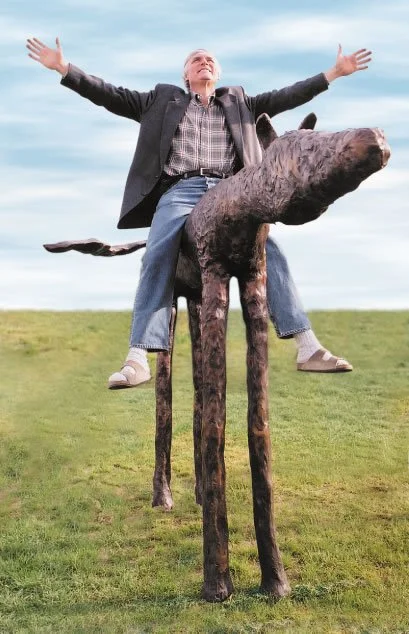
Budish’s curiosity of this world is a common thread through out his work. Heartened by the animals in his life Budish was inspired to make them his main artistic focus. Aiming to convey their unique movement and emotion or spirit. He has never been interested in creating “portraits in clay”, rather he has created his own unique direction in representing both the human form and the forms of the multitude of special creatures that surround us.
Best described in his own words:
“Through my art I attempt to discover and expose the ‘Joie De Vivre’ that I believe is ‘lurking’ somewhere inside of all of us. My minimalist approach and simple economy of line are my attempt to capture the pure essence of my subject’s personality, emotion and attitude.”
Budish’s main influences are Marino Marini, Alberto Giacometti and Chuck Jones
Jim Budish’s work has won prizes to include over 16 best in show honors. They are featured in many public art installations from parks to urban landscapes worldwide and held by numerous significant private collections.
Studio Partners and Best Friends
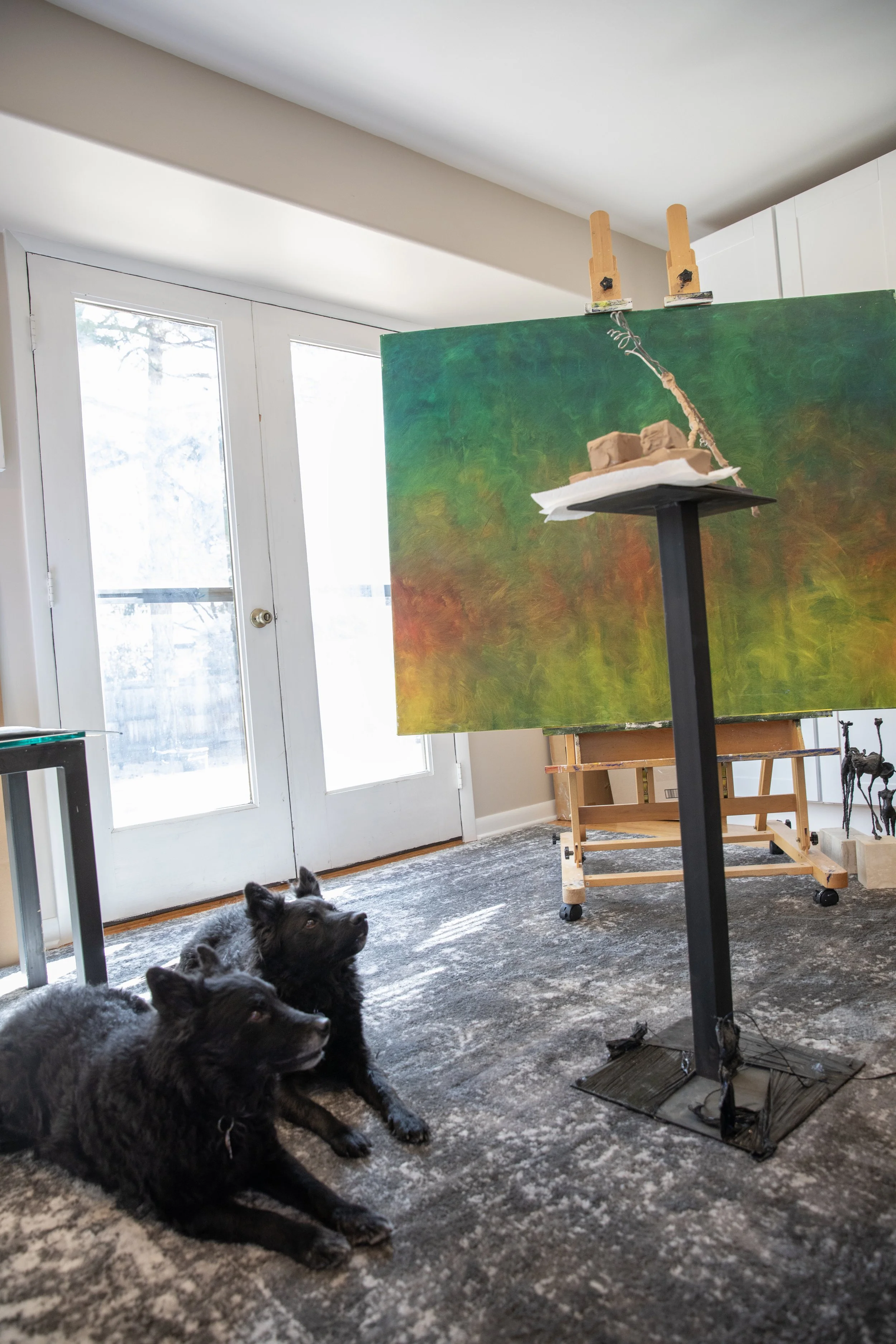
Jim has never worked alone. Two devoted studio companions have kept him company for years, curled at his feet or sprawled across whatever floor space they can claim. As a sculptor who has spent decades giving animals their dignity in bronze, Jim finds it fitting that his two dogs are among his most attentive observers. They watch every new piece take shape with what can only be described as deep, considered interest, and an occasional skeptical tilt of the head. Their opinions, while nonverbal, arrive with great conviction. Jim wouldn't have it any other way.